
DEVELOPERS
“The engine that makes integrations behave.”

Strawbay ships complex financial integrations fast, and keeps them stable at any volume. That comes from the engine: a console and a domain-specific language, with an agent layer built in.
“A flow is assembled from packages and recipes, the same standardized building blocks every time. A new customer or system is mostly a matter of choosing the right parts, not writing new ones.”
Sergei Kovalov, Lead Engineer, Strawbay · Read the article
The engine
A console and a DSL, with an agent layer built in
Our core is a console and platform built on a domain-specific language (DSL), with a no-code IDE at its heart. The DSL lets us deliver complex integrations significantly faster and keep them stable regardless of volume, and it lets an agent layer work as an integral part of the console rather than a bolt-on.

Built on clear separation
Integration logic and engine core, kept apart
Integration code, separate from executable code
Each integration is written as a DSL script, kept apart from the engine’s executable runtime, so it can be built and shipped without touching the core.
Engine core, separate from the user layer
Console, core and execution are kept apart, and each integration runs in its own isolated, short-lived environment, so one change cannot quietly destabilise another.
Built for reusability and rapid adoption
Reusable building blocks, fast delivery
Speed comes from not rebuilding the same thing twice. Strawbay assembles integrations from reusable building blocks, so a new customer or system goes live in a fraction of the usual time, and stays stable as you scale.
Integration Packages
Ready-made bundles for a use case: one connection plus the standardized flows that run it. Choose a package and a customer is most of the way there on day one.
Application Recipes
Every application has a reusable recipe. Connect an ERP, bank or agent once, then reuse that recipe across every customer that runs it.
A fast delivery model
Packages and recipes turn multi-tenant onboarding into assembly, not bespoke projects. That is what makes delivery exceptionally fast across many customers and systems.
An example
A factoring setup, drawn out
The same building blocks in action: three ERP factoring packages, each running the standardized flows, consolidated into one master system.
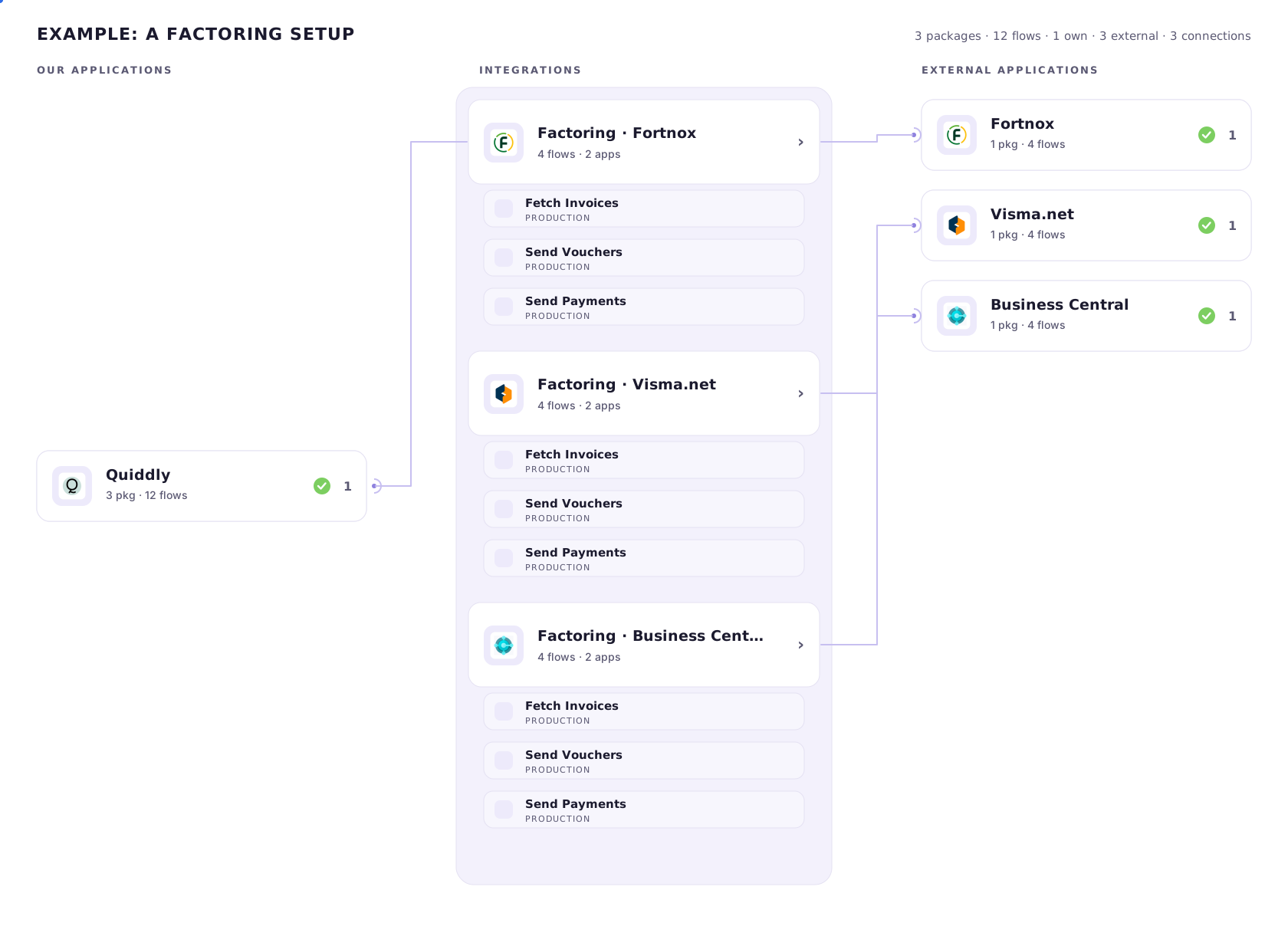
This architecture is what lets the same flows behave identically across every connected system. For how we build, test and release it safely, see our Development Methodology.